You're paying for empty deck.
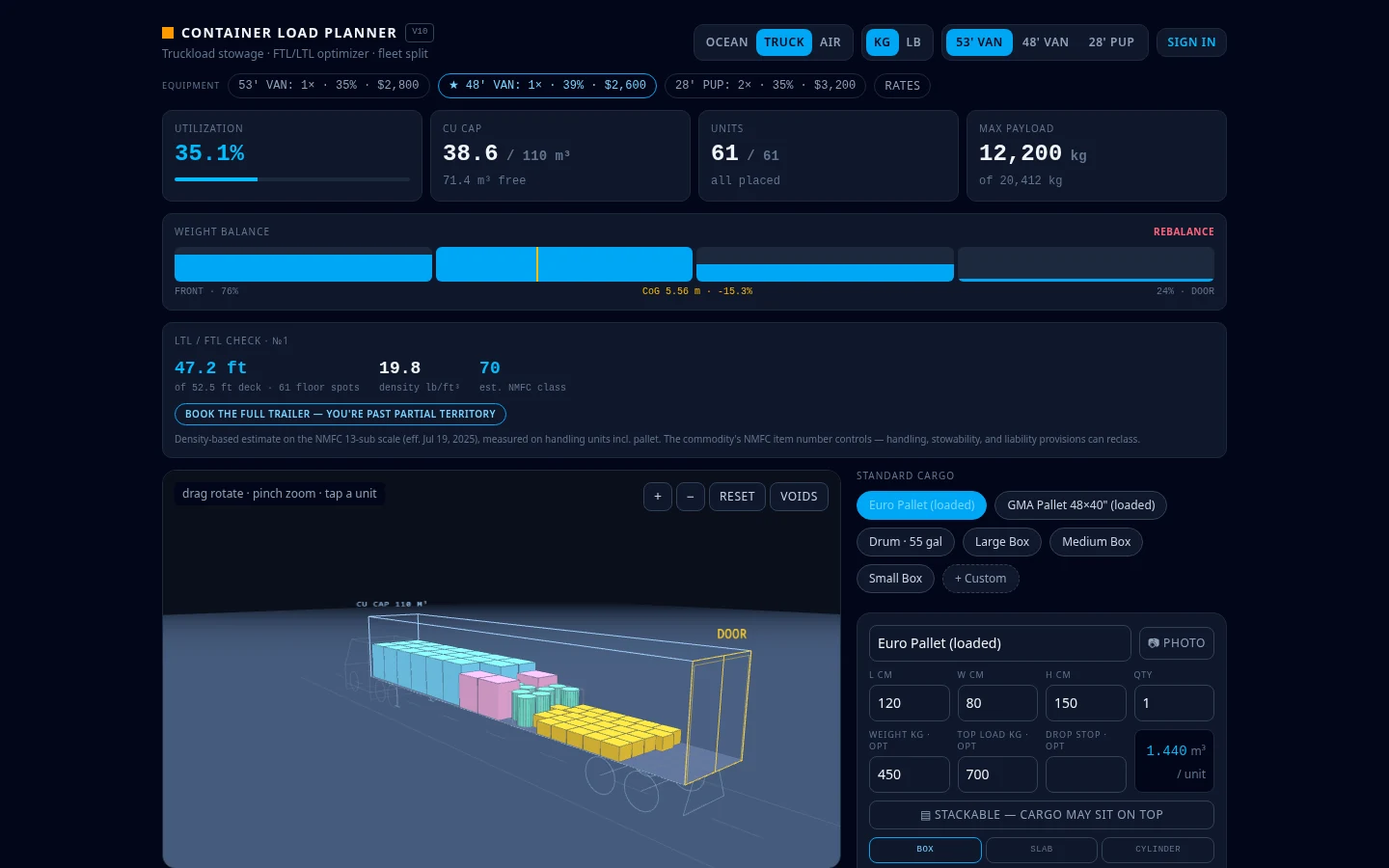
Every trailer you book ships at full price whether the deck is full or half empty. Container Load Planner packs 53' and 48' dry vans and 28' pups in live 3D — linear feet, density, and NMFC freight class computed instantly — so you stop paying full-trailer money for half-trailer freight.
53' dry van · 48' dry van · 28' pup · linear feet · NMFC 13-sub class · 12-ft LTL rule · multi-stop · weight-aware · PDF load plans · reefer · flatbed · step deck · box truck
Book a truckload and you pay for 52 feet of deck whether you use it or not. At 60% cube utilization, 40% of every trailer you buy rolls empty. Ship 5 loads a week and that's 2 full trailers of paid-for empty deck — every week.
And on the LTL side, class is money: the NMFC moved to a pure density scale in July 2025 — freight that packs denser books a lower class. Know your density before the carrier does.
Illustrative at $2,800/load — set your own lane rates inside the app.
How much empty deck are you buying?
A dispatcher's toolkit, in the browser.
Live 3D trailer packing
53' and 48' dry vans and the 28' pup, packed by the same first-fit-decreasing engine that plans ocean containers — redrawn as you type.
Linear-feet tracking
Live feet of deck consumed, with the 12-linear-foot LTL capacity rule flagged the moment your shipment crosses it.
NMFC freight class, automatically
Per-item and whole-shipment density in lb/ft³, mapped to an estimated class on the current 13-sub scale effective July 19, 2025.
Pallet building
Build pallets from cartons and see the layers, stack height, weight, density and the estimated NMFC class the finished pallet earns.
LTL / Volume / FTL advisory
A live recommendation as the load grows: standard LTL, volume-partial, or book the full trailer.
Weight-aware stacking
Per-item top-load limits and 45,000 lb payload caps — dense freight weighs out before it cubes out, and the planner says so.
Multi-stop routes
Tag unload stops and the engine loads in reverse: stop 1 packs at the doors, the last stop rides at the nose.
Drag-to-pin control
Override the algorithm — drag any unit into place on the deck and the engine packs around it.
Excel / CSV import + AI photo capture
Drop your manifest in, or photograph a pallet and let AI size it.
PDF load plans
Crew-ready sequence sheets with linear feet and estimated class printed per trailer.
Load your freight
Import your manifest, pick from presets, or photograph the pallets on your dock.
The engine packs the trailer
Utilization, linear feet, density, estimated class and weight balance — live.
Book it right
Standard LTL, volume, or full trailer — with a PDF the dock can load from.
The 12-foot line
Cross 12 linear feet of deck with a single shipment and LTL capacity pricing kicks in — the same freight is suddenly quoted like partial truckload. The planner shows your feet of deck live as you build the manifest and flags the crossover before the carrier does, so you choose the pricing model instead of discovering it on the invoice.
Class is a number you can move
Since July 2025 freight class is density: pounds per cubic foot of the handling unit, mapped onto a 13-subprovision scale. Pack the same freight tighter and you book a lower class for the same goods. Per-item C-class chips show exactly which lines are costing you, so you know where a taller pallet or a tighter stack pays for itself.
- ·Ocean + truck modes
- ·All trailers & containers
- ·Linear ft + freight class intelligence
- ·PDF load plans
- ·Read-only share links
- ·Saved plans
- ·Custom presets with photos
One subscription, every mode. Free to analyze — subscribe to export, save, and share.
Free accounts include one saved plan.
Put load planning inside your own systems. We work with a small number of partners to expose the planning engine — cargo in, load plan out — so your TMS, quoting screen or customer portal can show utilisation, weight balance, freight class and chargeable weight without anyone opening a browser.
- ·Planning engine in your own TMS, portal or ERP
- ·Multi-seat teams and multiple branches
- ·Custom equipment libraries and house rules
- ·Volume pricing and onboarding
- ·Priority support and a named contact
Currently scoping integrations with early partners — tell us what you'd connect and we'll come back with a plan and pricing.
Questions shippers ask
? What is the 12-linear-foot rule?
Most LTL carriers apply capacity-load pricing once a single shipment occupies about 12 linear feet of trailer deck or more — the freight stops being ordinary LTL and starts being priced like partial or volume truckload. The planner tracks your linear feet live as you add freight, so you see the crossover coming and can decide between standard LTL, a volume quote, or booking the full trailer before the carrier decides for you.
? How is freight class calculated now?
The NMFC moved to a pure density scale effective July 19, 2025, replacing the old commodity-by-commodity groupings with a 13-subprovision structure. Density is measured on the handling unit as tendered — pallet, skid or crate included — so the pallet's own cube and weight count. The planner computes pounds per cubic foot per line and for the whole shipment and shows the estimated class from that. It is an estimate: the governing NMFC item number for your commodity always controls the final class on the bill.
? Can it tell me LTL vs partial vs full truckload?
Yes. The LTL/FTL Check panel gives a live advisory from your linear feet and total weight: standard LTL while the shipment is small, volume/partial once it crosses the capacity thresholds, and 'book the full trailer' when the deck or the payload is effectively consumed. It updates on every manifest change.
? Can I build pallets from cartons?
Yes. Build the pallet from your carton dimensions first — pick the base (Euro, GMA 48×40in, half Euro, industrial or custom), set the max build height and weight limit, and the planner shows layers, stack height, total weight including pallet tare, density and the estimated NMFC class the finished pallet earns. Then load the built pallets onto the trailer like any other handling unit, with linear feet and class updating live.
? Which trailers does it support?
53' and 48' dry vans and the 28' pup, 53' reefer, 48' and 53' flatbed, step deck lower and upper, 26' / 24' / 16' box trucks, the extended cargo van, and the 40' gooseneck hotshot. All of them run through the same 3D packing engine, with door aperture clearance, top-load limits and payload caps enforced. Specs are nominal and every unit can be duplicated and edited to match your equipment — or you can build your own from scratch on the full platform.
? Does it handle multi-stop loads?
Yes. Tag any manifest line with a stop number and the engine packs in reverse unload order: the last stop sits deepest against the nose, stop 1 sits at the doors. The load sequence and the PDF sheet follow the same order, so the driver never digs to reach the first delivery.
? What does it cost?
$199/month for the full platform, and that one subscription covers every mode — ocean containers and truck trailers alike. Analyzing loads, importing manifests, and the full live 3D planner are free; the subscription unlocks PDF load plans, share links, saved plans and custom presets.
? Do ocean and truck share one account?
Yes — it is one platform. Your account, saved plans, custom packages with photos and your subscription all work across ocean and truck modes. Switch modes with the OCEAN | TRUCK pill in the planner header; the same cargo manifest can be packed into a container or onto a trailer.
? Do you offer an API or integrations?
The planning engine is being made available to enterprise partners, and we're actively scoping integrations now — quoting screens, customer portals, ERP and TMS flows. To be clear: there is no self-serve API you can sign up for today. Tell us what you'd connect on the enterprise page and we'll come back with a plan, timeline and pricing.
You aren't taking full advantage of the trailers you're already booking.
At 60% cube you pay for 2 empty trailers every 5 loads. Get them back.
Launch the truck planner — free