You're losing containers every month.
Not to carriers — to unused space. Container Load Planner packs your ocean freight in live 3D so every container you already book leaves at its full CBM potential. Shippers running below 75% utilization are giving away five to seven figures a year.
20' STD · 40' STD · 40' HC · weight-aware stacking · door clearance · multi-drop zones · photo-to-3D cargo · PDF load plans · 53' & 48' dry vans · 28' pup · NMFC freight class · reefers · open tops · flat racks
Book a container and you pay the full rate whether it leaves full or 60% full. At 60% utilization, 40% of every container you buy goes unused. Every 3 shipments, that's 120% of a container — 1.2 full boxes you paid for and never used.
Run 10 a week and the same leak approaches $1M a year. High-volume programs lose millions.
Illustrative at $5,000/container — set your own lane rates inside the app.
How many containers are you losing?
A stowage planner's toolkit, in the browser.
Live 3D Tetris packing
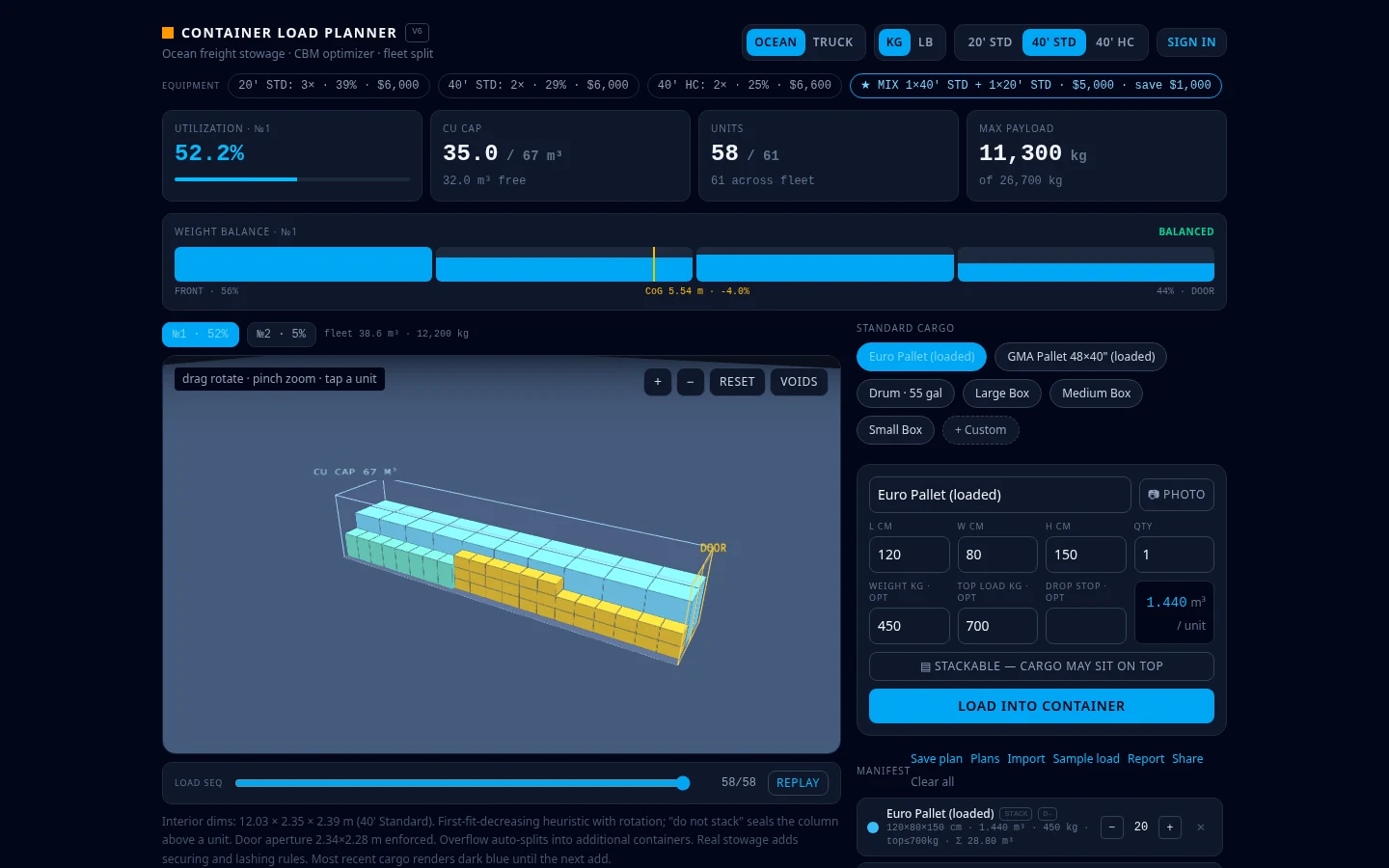
A first-fit-decreasing engine packs every box in real time — watch the container fill as you type.
Weight-aware stacking
Per-item top-load limits and container payload caps. Nothing heavy lands on anything fragile.
Photograph your cargo
Photograph your cargo — AI identifies it, estimates dimensions and stacking rules, and renders it on your real 3D load.
Pallet building
Build a pallet from your carton dimensions — layers, stack height, weight and density — then load the finished pallets into any container.
Custom packages
Save your own SKUs with dimensions, weight, stack rules and photos. Reuse them on every shipment.
Multi-drop zones
Tag unload stops: stop 1 packs at the doors, deep stops go to the front wall.
Drag-to-pin control
Override the algorithm — drag any unit into place and the engine packs around it.
Mixed-fleet + equipment calculator
Compare 20', 40' and 40'HC fleets and get the cheapest combination, priced with your own rates.
Excel / CSV import
Drop your manifest in. Unit sniffing handles cm/in/mm and kg/lb without cleanup.
PDF load plans + share links
Crew-ready load sequence sheets and read-only links for partners and forwarders.
Load your manifest
Import Excel or CSV, pick from presets, or photograph your cargo.
The engine packs it in live 3D
Utilization, weight balance, door clearance and drop order — instantly.
Ship the plan
PDF sequence sheet, share link, and a crew that loads exactly what it says.
Tetris, but the blocks are your revenue
Every unit is placed largest-first onto a height map of the floor, tested in both rotations, and dropped into the lowest, deepest slot that holds its weight. The utilization number updates as you type — so you can see a 60% load become an 88% load before you ever book the box.
From phone photo to 3D load plan
Photograph a carton on the warehouse floor, enter its dimensions and weight, and that photo is mapped onto the unit's faces in the 3D scene. Your real product is recognizable inside any container type — and saved as a reusable custom package.
- ·Unlimited load plans
- ·All container types + mixed fleets
- ·Photo cargo + custom packages
- ·Excel / CSV import
- ·PDF load plan reports
- ·Read-only share links
- ·Priority updates
Free to analyze — run your manifest and see your savings at no cost. Subscribe to export, save, and share.
Free accounts include one saved plan.
Put load planning inside your own systems. We work with a small number of partners to expose the planning engine — cargo in, load plan out — so your TMS, quoting screen or customer portal can show utilisation, weight balance, freight class and chargeable weight without anyone opening a browser.
- ·Planning engine in your own TMS, portal or ERP
- ·Multi-seat teams and multiple branches
- ·Custom equipment libraries and house rules
- ·Volume pricing and onboarding
- ·Priority support and a named contact
Currently scoping integrations with early partners — tell us what you'd connect and we'll come back with a plan and pricing.
Questions shippers ask
? What is CBM utilization?
CBM utilization is the share of a container's cubic-meter capacity your cargo actually occupies. A 40' standard box holds about 67 m³; if your load only fills 40 m³ you are at 60% utilization. Every percentage point below full is freight spend on empty space, because ocean carriers bill the container, not the cubic meters inside it.
? How much can I actually save?
At 60% utilization, 40% of every container you buy is unused space you paid for. One container a week at a $5,000 lane rate is roughly $8,000 a month of paid-for empty space — about $96,000 a year that better packing can recover. Run ten containers a week on the same lane and the same leak approaches $1M a year; high-volume programs lose millions.
? How does the 3D packing work?
Cargo is sorted by volume and placed largest-first onto a height map of the container floor, testing both rotations at every candidate position and keeping the lowest, deepest fit. The engine tracks per-item top-load limits so nothing gets crushed, respects payload caps, and checks door aperture clearance before a unit is accepted. It is the same reasoning a stowage planner applies by hand, executed in milliseconds and redrawn live in 3D.
? Can I use photos of my real cargo?
Yes. Snap or upload a photo of a carton, drum or crate and it is rendered as the texture on that unit's 3D boxes, so your actual product is recognizable inside the container. AI also identifies what it sees and estimates the shipping dimensions, weight and stacking rules for the handling unit as tendered — every estimate stays fully editable, and you verify it against your actual freight before shipping. Photos can be saved onto custom packages and reused on every future shipment.
? Can I build pallets from cartons?
Yes. Enter your carton dimensions, weight and quantity, pick a pallet base (Euro, GMA 48×40in, half Euro or industrial), set a max build height and weight limit, and the same 3D engine builds the pallet — showing layers, achieved stack height, total weight with tare, cube utilisation and density. Add the finished pallet to your manifest and load it like any other unit; save it as a reusable package with the recipe attached.
? Which containers does it support?
20', 40', 40' HC and 45' HC dry boxes, 20' and 40' HC reefers, 20' and 40' open tops, 20' and 40' flat racks, and the 53' domestic container. All of them run through the same 3D packing engine, with door aperture clearance, top-load limits and payload caps enforced. Specs are nominal and every box can be duplicated and edited to match your carrier's equipment — or you can build your own from scratch on the full platform.
? Does it handle multiple delivery stops?
Yes. Tag any manifest line with a drop stop number and the engine packs in reverse unload order into strict longitudinal zones: the last stop sits deepest against the front wall and stop 1 sits at the doors, so the crew unloads without digging. The load sequence and PDF follow the same order.
? What does it cost?
$199/month for the full platform — PDF load plans, share links, saved plans, and custom packages with photos. Analyzing loads, importing manifests, and the full 3D planner are free.
? Does it support LTL/FTL trucking or air freight?
Yes — all three modes are live today. Ocean packs containers, Truck mode handles LTL/FTL with linear-feet tracking, the 12-linear-foot LTL capacity rule, and estimated NMFC density class on the current 13-sub scale (effective July 19, 2025), and Air mode builds up ULDs with 1:6000 chargeable weight. One subscription, the same live 3D packing engine.
? Do you offer an API or integrations?
The planning engine is being made available to enterprise partners, and we're actively scoping integrations now — quoting screens, customer portals, ERP and TMS flows. To be clear: there is no self-serve API you can sign up for today. Tell us what you'd connect on the enterprise page and we'll come back with a plan, timeline and pricing.
You aren't taking full advantage of the containers you're already booking.
At 60% utilization you lose 1.6 containers a month. Get them back.
Launch the live planner — free