Your freight class is decided before the truck arrives.
LTL class is density measured on the handling unit as tendered — the pallet you build IS the rate you pay. Container Load Planner stacks your mixed cartons onto Euro, GMA, half-Euro, industrial or custom pallets in live 3D, shows layers, stack height, weight and density as you build, and computes the NMFC class the finished pallet earns — before a carrier ever measures it.
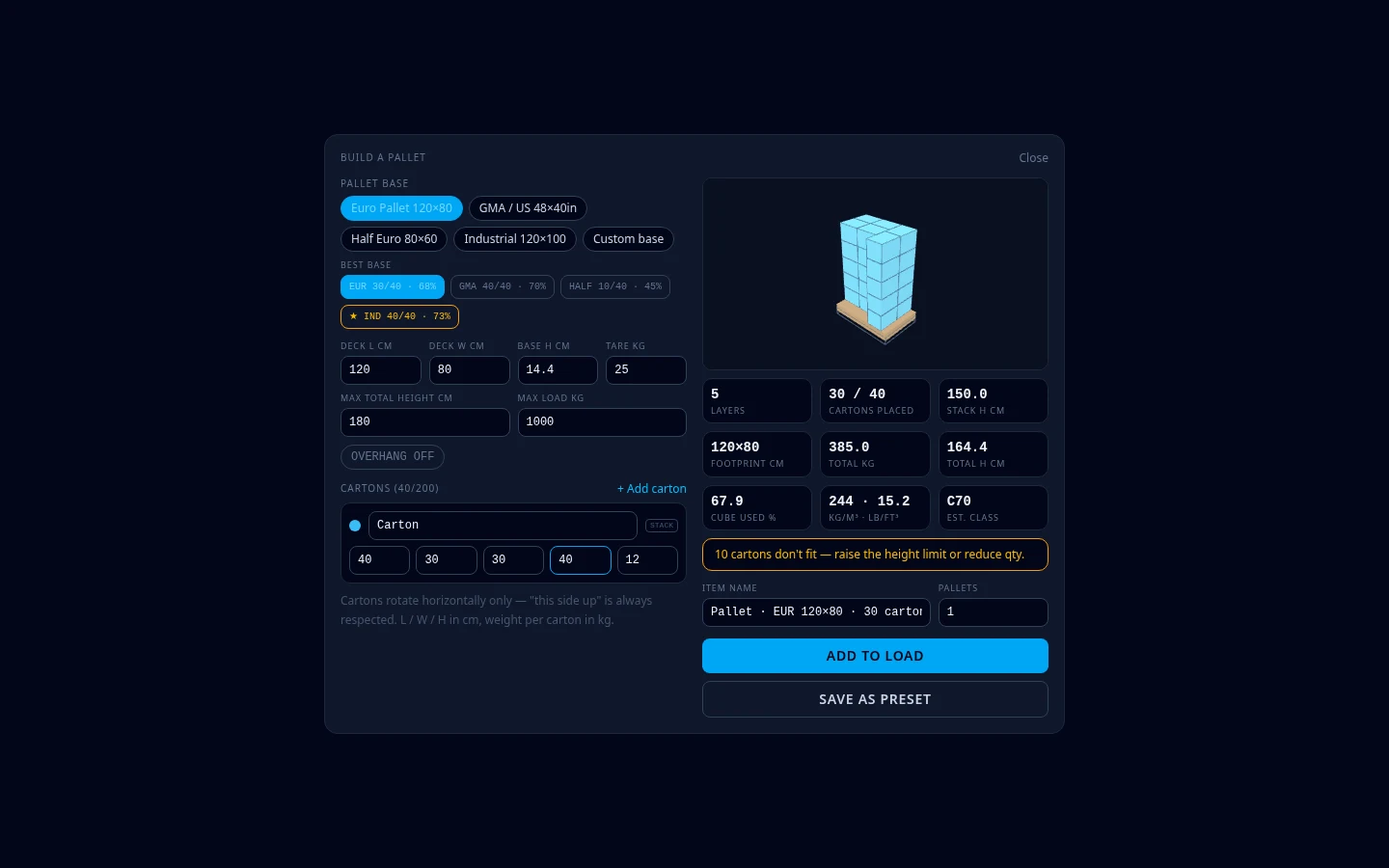
Euro 120×80 · GMA 48×40 · half-Euro · industrial · custom decks · layers · stack height · kg/m³ · lb/ft³ · NMFC class · best-base advisory
Every pallet position you book — LTL spot, trailer footprint, storage slot — is paid for whether the cube is full or not. Ship 50 pallets a week built to 60% and the same freight fits on 37 or 38 pallets built to 80%. The rest is spend.
Illustrative at $144 per position — set your own rates below.
How many pallets are you paying for twice?
Everything that decides the rate, before you tender.
Build from mixed cartons
Any number of SKUs onto one pallet — different dimensions, weights and stack rules, packed by the same 3D engine that plans containers and trailers.
Best-base advisory
The builder packs your exact cartons onto every standard base — Euro, GMA, half-Euro, industrial — and stars the winner. One tap switches to it.
Freight class on the finished pallet
Identical math to truck mode, run on the handling unit as tendered. The class shown here can never disagree with your load plan.
Density in both units
kg/m³ and lb/ft³ side by side, recomputed on every keystroke, so you can see the class boundary coming before you cross it.
Overhang, honestly
Allow overhang per side and the reported footprint grows to the real extent of the cargo — with a note to confirm carrier approval.
Weight limits & tare
Pallet tare is counted in the total and an over-limit advisory appears when you pass your own weight cap. It informs — it never blocks.
3D preview with photo-real cargo
Watch the stack build layer by layer, and AI photo capture feeds the builder so your actual cartons are recognizable on the deck.
Reusable pallet recipes
Save a finished pallet as a custom package, reopen and edit it any time, and the recipe travels inside share links.
The bigger picture
Load finished pallets straight into ocean containers, truck trailers and air ULDs. One engine, one account, one subscription.
Enter your cartons
Dimensions, weight and quantity per SKU — or import them, or photograph them on your dock.
The engine stacks the pallet
Layers, stack height, weight with tare, cube utilization, density and the estimated class — live in 3D.
Load it or tender it
Add the finished pallets to a container, trailer or ULD, or hand the class and dimensions straight to your carrier.
Class is set at the pallet
The 13-subprovision density scale, effective July 19 2025, measures the handling unit as tendered — pallet included. Rebuild the same cartons tighter and the density rises, the class drops, and the LTL invoice follows. Nothing about the goods changed; only the way they were stacked.
The best base isn't a guess
The advisory packs your exact cartons on Euro, GMA, half-Euro and industrial decks and stars the winner by cartons placed, then cube. Switch with one tap and the whole build — layers, height, density, class — recomputes to match.
- ·Ocean + truck + air modes
- ·Pallet building + best-base advisory
- ·Every container, trailer & ULD
- ·Freight class, linear feet + chargeable weight
- ·PDF load plans
- ·Read-only share links
- ·Saved plans
- ·Custom presets with AI capture
One subscription, every mode. Free to analyze — subscribe to export, save, and share.
Free accounts include one saved plan.
Put load planning inside your own systems. We work with a small number of partners to expose the planning engine — cargo in, load plan out — so your TMS, quoting screen or customer portal can show utilisation, weight balance, freight class and chargeable weight without anyone opening a browser.
- ·Planning engine in your own TMS, portal or ERP
- ·Multi-seat teams and multiple branches
- ·Custom equipment libraries and house rules
- ·Volume pricing and onboarding
- ·Priority support and a named contact
Currently scoping integrations with early partners — tell us what you'd connect and we'll come back with a plan and pricing.
Questions shippers ask
? How does the pallet calculator work?
You enter your carton dimensions, weight per carton and quantity, pick a pallet base and set a max build height and weight limit. The same 3D packing engine that plans containers and trailers stacks the cartons onto the deck, then reports layers, achieved stack height, total weight including pallet tare, cube utilization, density in kg/m³ and lb/ft³, and the estimated NMFC freight class the finished pallet earns. Everything recomputes live as you type.
? Which pallet bases are supported?
Euro 120×80 cm, GMA / US 48×40 in, half-Euro 80×60 cm and industrial 120×100 cm, plus a fully custom base where you set the deck length, deck width, base height and tare weight yourself. Each standard base carries its real deck height and typical tare so the finished pallet's weight and cube are honest.
? Can it tell me which base is best?
Yes. The best-base advisory packs your exact cartons onto every standard base — Euro, GMA, half-Euro and industrial — using your current height limit, weight limit and overhang setting, then stars the winner by cartons placed, tie-broken on cube utilization. Tap any base in the strip to switch to it and the whole build recomputes.
? Does it compute freight class?
Yes. It measures the density of the finished pallet — deck footprint, total build height and total weight including tare — and reads the class off the current 13-subprovision NMFC density scale using the same helper truck mode uses, so the number here can never disagree with your load plan. It is an estimate to verify against the governing NMFC item number for your commodity.
? What about cartons bigger than the deck?
Turn overhang on and set the allowance per side. The engine then packs the larger envelope and the reported footprint grows to the real extent of the cargo — not the deck — so the density and class reflect what the carrier will actually measure. The builder flags the overhang so you can confirm your carrier accepts it.
? Can I load built pallets into containers and trailers?
Yes. The finished pallet becomes a normal handling unit on your manifest with its real footprint, build height and total weight, and loads into ocean containers, truck trailers and air ULDs like anything else. The recipe stays attached — reopen it any time to rebuild, and it travels inside share links.
? What does it cost?
$199/month for the full platform, covering every mode. Building pallets and analyzing loads is free; saving recipes as reusable packages, PDF export and share links are subscriber features.
Build the pallet before the carrier bills it.
50 loose pallets a week is ~$86,400 a year of empty cube. Rebuild them.
Build a pallet — free