You're being billed for weight that isn't there.
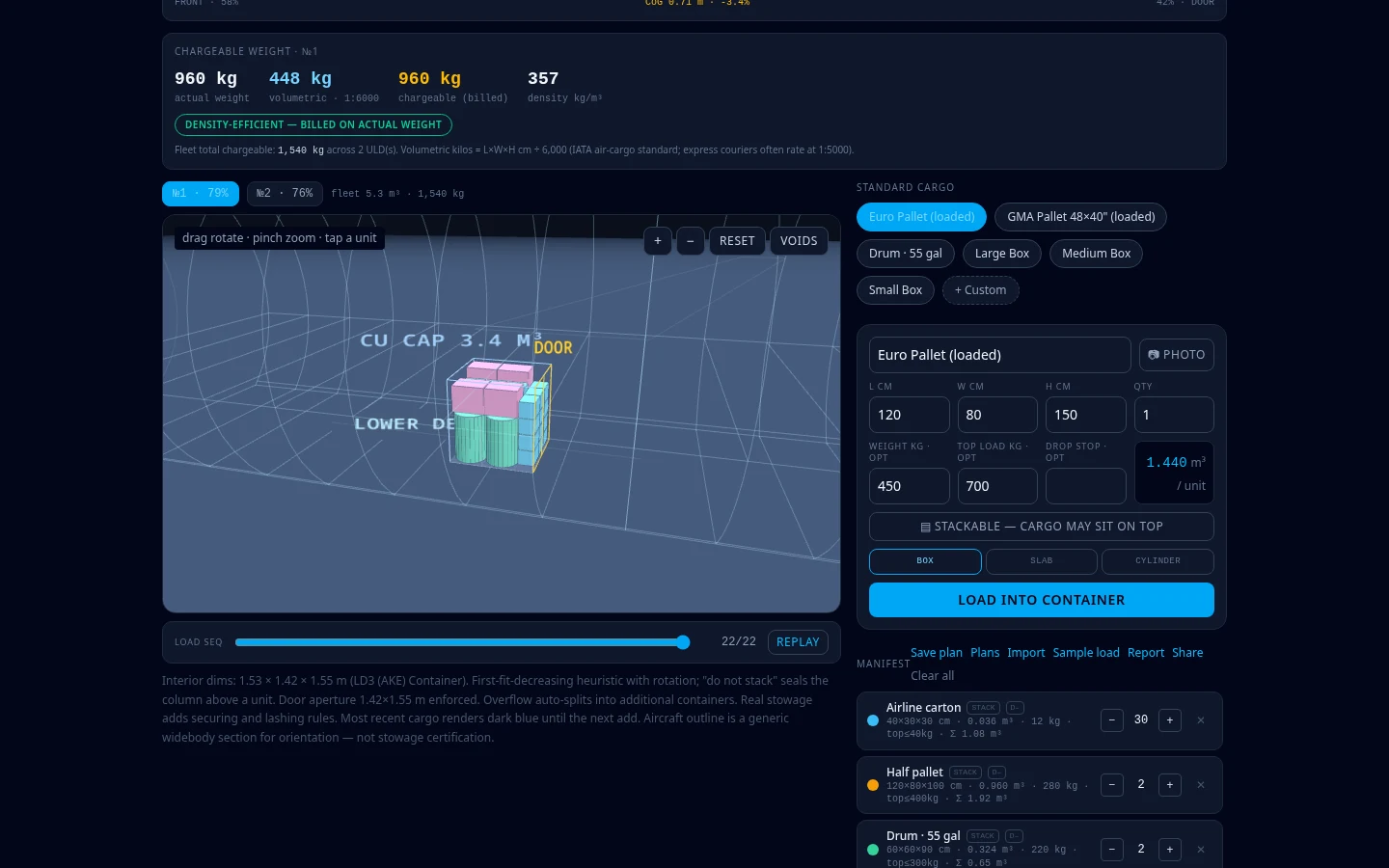
Air freight is billed on chargeable weight — the greater of actual kilos and volumetric kilos at 1:6000. Loose ULD build-ups inflate the volumetric number, and the airline invoices the difference. Container Load Planner packs LD3 containers and PMC pallets in live 3D and shows your chargeable weight before the airline does.
LD3 · AKE · PMC pallets · lower deck · main deck · 1:6000 dim weight · chargeable kg · build-up sheets · LD1–LD11 · PMC · PAG · AMA
Every air waybill is rated on chargeable weight. Tender 1,800 actual kilos built loosely into 2,400 volumetric kilos and you pay for 2,400 — a 600 kg gap, invoiced at full rate, on every shipment.
Illustrative at $4.50/kg — set your own rates inside the app.
How much dim weight are you paying for?
A build-up supervisor's toolkit, in the browser.
Live 3D ULD build-up
LD3 (AKE) containers and PMC pallets in both lower- and main-deck heights, packed by the same first-fit-decreasing engine that plans containers and trailers.
Chargeable weight, live
Actual kilos, volumetric kilos at 1:6000 and the billed number side by side — recalculated on every manifest change.
Dim-weight advisory
Per ULD and per item: see exactly which SKUs push volumetric above actual and inflate the invoice.
Strict ULD payload caps
1,500 kg net on the LD3, 4,500 and 6,690 kg on PMC lower and main deck. Dense freight weighs out fast, and the planner says so before the build.
Contour-honest packing
We pack the rectangular envelope that fits inside the AKE contour — the chamfered corner is excluded on purpose, so every slot shown is a slot your crew can fill.
AI photo capture
Photograph a carton or skid and AI identifies it, estimates the tendered dimensions, weight and stacking rules, then renders it on the real 3D build-up.
Excel / CSV import
Drop your manifest in. Unit sniffing handles cm/in/mm and kg/lb without cleanup.
Multi-ULD splits + MIX compare
Overflow spills into more ULDs automatically, and the equipment calculator finds the cheapest LD3 / PMC combination at your own rates.
PDF build-up sheets
Crew-ready position sheets with chargeable weight, actual and volumetric printed per ULD.
Load your shipment
Import your manifest, pick from presets, or photograph the freight on your dock.
The engine builds the ULD
Utilization, payload, density and chargeable weight at 1:6000 — live in 3D.
Tender it knowing the number
Close the dim gap before the airline rates it, and hand the crew a PDF build-up sheet.
The 1:6000 rule
Volumetric kilos are length × width × height in centimetres divided by 6,000. The planner computes it live per ULD as you pack, alongside actual weight and the resulting chargeable figure. Express couriers commonly use 1:5000, which rates the same freight higher — we rate at the IATA air-cargo standard so the number you plan against is the conservative one.
Density is the rate you pay
The gap between actual and volumetric is pure invoice. Pack the same freight tighter and chargeable weight falls toward actual — the same kilos, a smaller bill. Per-item DIM chips in the manifest show exactly which SKUs are inflating the number, so you know which lines to re-cube first.
- ·Ocean + truck + air modes
- ·Every container, trailer & ULD
- ·Chargeable weight, freight class + linear-feet intelligence
- ·PDF load & build-up plans
- ·Read-only share links
- ·Saved plans
- ·Custom presets with AI capture
One subscription, every mode. Free to analyze — subscribe to export, save, and share.
Free accounts include one saved plan.
Put load planning inside your own systems. We work with a small number of partners to expose the planning engine — cargo in, load plan out — so your TMS, quoting screen or customer portal can show utilisation, weight balance, freight class and chargeable weight without anyone opening a browser.
- ·Planning engine in your own TMS, portal or ERP
- ·Multi-seat teams and multiple branches
- ·Custom equipment libraries and house rules
- ·Volume pricing and onboarding
- ·Priority support and a named contact
Currently scoping integrations with early partners — tell us what you'd connect and we'll come back with a plan and pricing.
Questions shippers ask
? What is chargeable weight?
Air freight is rated on the greater of two numbers: the actual scale weight of your shipment and its volumetric weight. Volumetric weight is length × width × height in centimetres divided by 6,000 — the IATA air-cargo standard. Whichever is larger is what the airline invoices. Express couriers frequently rate at 1:5000, which produces an even higher number; the planner rates at 1:6000 so the figure you see is the conservative air-cargo one.
? Which ULDs are supported?
LD1 (AKC), LD2 (DPE), LD3 (AKE), LD6 (ALF), LD7 / PAG pallet, LD9 / AMA main deck, LD11 (ALP), and the PMC pallet in both build heights — lower deck and main deck. All of them run through the same 3D packing engine as the containers and trailers. Specs are nominal and every ULD can be duplicated and edited to match your carrier's build, or you can define your own on the full platform.
? Why rectangular packing inside a contoured container?
The AKE's chamfered lower corner is deliberately excluded. The planner packs the largest rectangular envelope that fits inside the contour, so every position it shows you is a position your build-up crew can actually fill. It is conservative on purpose: the plan never promises volume that the contour takes away.
? Can it split across multiple ULDs?
Yes. Overflow spills automatically into additional ULDs of the same type, and the equipment calculator compares pure fleets of LD3, PMC lower deck and PMC main deck plus mixed combinations, priced with your own per-ULD rates. Each ULD gets its own utilization, payload check and chargeable weight.
? Does the truck & ocean cargo library carry over?
Yes — one platform, one account. Saved plans, custom packages with photos and AI capture, imported manifests and your subscription all work across ocean, truck and air. The same manifest can be packed into a 40' container, onto a 53' trailer, or built up onto a PMC pallet.
? What does it cost?
$199/month for the full platform, covering every mode — ocean containers, truck trailers and air ULDs. Analyzing loads, importing manifests and the full live 3D planner are free; the subscription unlocks PDF build-up sheets, share links, saved plans and custom presets.
? Do estimates replace airline weighing?
No. These are plan-side numbers meant to be verified before tender: they show you what your build-up will likely be rated at so you can tighten it, re-cube it, or re-quote it in advance. The airline's own scale and dimensioner produce the figure on the air waybill.
? Do you offer an API or integrations?
The planning engine is being made available to enterprise partners, and we're actively scoping integrations now — quoting screens, customer portals, ERP and TMS flows. To be clear: there is no self-serve API you can sign up for today. Tell us what you'd connect on the enterprise page and we'll come back with a plan, timeline and pricing.
Stop paying freight rates on empty volume.
A 600 kg dim gap at $4.50/kg is $2,700 gone per shipment. Close it.
Launch the air planner — free